7am walk up Moel Famau with the kids to have breakfast. It was a beautiful morning on a day the wind was zero and the temperature later that day hit 28c/82f.
Moel Famau is the highest hill in the Clwydian Range and the highest point (county top) of the county of Flintshire in Wales (both the historic county and the current council area). It lies on the boundary between Denbighshire and Flintshire. The hill, which also gives its name to the Moel Famau country park, has been classed as an Area of Outstanding Natural Beauty since 1985. It is also surrounded by several well-preserved Iron Age hill forts. It is not, as many people think, the highest peak in North-East Wales; this honour goes to Cadair Berwyn. It is also the third-highest peak in the extended AONB of The Clwydian Range and Dee Valley.
A quick flight over the entrance to the Manchester Ship Canal at Eastham, Wirral.
The Manchester Ship Canal is a 36-mile-long (58 km) inland waterway in the North West of England linking Manchester to the Irish Sea. Starting at the Mersey Estuary near Liverpool, it generally follows the original routes of the rivers Mersey and Irwell through the historic counties of Cheshire and Lancashire. Several sets of locks lift vessels about 60 feet (18 m) to the canal’s terminus in Manchester. Landmarks along its route include the Barton Swing Aqueduct, the world’s only swing aqueduct, and Trafford Park, the world’s first planned industrial estate and still the largest in Europe.
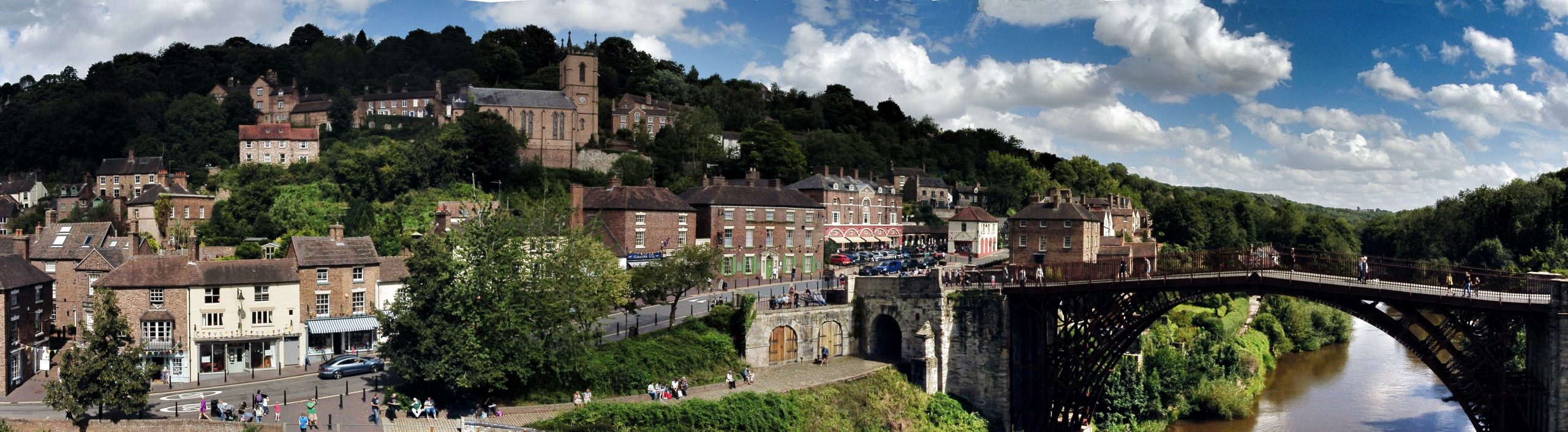
Had the pleasure of visiting the World Heritage Site of Ironbridge last week, what a beautiful place.
The wind was not on my side for getting some video of the birth place of the industrial revolution; however I did get a few shots off and pulled together my first panoramic.
Ironbridge
The panoramic is made up of 3 photos taken from above the river with my DJI Mavic Mini and then stitched together with Affinity Photo then some colour editing with Snapseed.
I had a quick visit down to Eastham Ferry the other day to do a little flying. The original plan was to do some more shots over the River Mersay but again the wind was a little high for me to be comfortable also the area has a 60m high restriction in place so could get some of the shots I was looking for. 100% a place that I will visit and do some more flying.
Due to the limited footage to had to focus a little more on edit and using the music track to guild me.
History of Eastham Ferry
Since the Middle Ages, a ferry service operated across the River Mersey between Eastham and Liverpool, the early ferries being run by monks from the Abbey of St. Werburgh. By the late 1700s, up to 40 coaches each day arrived at a newly built pier, carrying passengers and goods for the ferry. Paddle steamers were introduced in 1816 to replace the sailing boats, but the demand for a service declined in the 1840s with the opening of a railway link between Chester and Birkenhead Woodside Ferry.
In 1846, the owner of the ferry, Thomas Stanley, built the Eastham Ferry Hotel and shortly after, the Pleasure Gardens were added to attract more visitors. The gardens were landscaped with rhododendrons, azaleas, ornamental trees and fountains. Attractions included a zoo, with bears, lions, monkeys and antelope, an open-air stage, tea rooms, bandstand, ballroom, boating lake, water chute. Entertainers performed in the gardens during summer, and included Blondin, the famous tight-rope walker who once wheeled a local boy across a high wire in a wheelbarrow. In 1894, the Manchester Ship Canal was opened by Queen Victoria, bringing added prosperity to the area and a Jubilee Arch was built at the entrance to the Pleasure Gardens in 1897 to commemorate her Diamond Jubilee. The ‘Bear Pit’ at Eastham Woodland & Country Park as it stood in 2006. In 1854 the American novelist Nathaniel Hawthorne, whilst in the position of United States consul in Liverpool, visited Eastham and declared it to be: “the finest old English village I have seen, with many antique houses, and with altogether a rural and picturesque aspect, unlike anything in America, and yet possessing a familiar look, as if it were something I had dreamed about.”
In its heyday Eastham Ferry was known as the ‘Richmond of the Mersey’, but its popularity declined during the 1920s and the last paddle steamer crossing took place in 1929. The Pleasure Gardens fell into disrepair during the 1930s and the iron pier and Jubilee Arch were later dismantled. In 1970, to commemorate European Conservation Year, the area was designated a Woodland & Country Park and today, it is once more a popular place of recreation.
My little attempt at the Tilt-Shift effect from a flyover of Mill Park Estate, Eastham. Edited together using LumaFusion on my iPhone. Not the best edit but considering the whole edit was a trial run I’m happy with the results for now.
Quick flight over Thor’s Rock (Thor’s Stone) in Thurstaton Common, Wirral today.
Thor’s Rock – Thurstaton Common, Wirral
I was out with the family so not loads of time to get lots of footage in; but this is a great place for flighting your Drone with views across the river into Wales.
Thurstaston Hill is the location of Thor’s Stone, a large sandstone outcrop and a place of romantic legend. In the 19th century it was supposed that early Viking settlers may have held religious ceremonies here. A visit to the site by members of the British Archaeological Association in 1888 heard an account by Rev. A. E. P. Gray, rector of Wallasey, that the ‘Thor Stone’ was also known in the locality as ‘Fair Maiden’s Hall’ and that children were “in the habit of coming once a year to dance around the stone”. This part of Wirral was certainly part of a Norse colony centred on Thingwall in the 10th and 11th centuries. However, geologists and historians now think that the rock is a natural formation similar to a tor, arising from periglacial weathering of the sandstone, which was later exploited by quarrymen in the 18th and 19th centuries.
It may have looked like a beautiful day but the wind was deceptive today and the bird was not100% stable in the air. This was my first flight using my new ND filers but no color correction has been used.
St Mary Church, Eastham
A place of worship has been here since before the time of the Domesday Book, which mentions a priest at Eastham. The present church contains architecture from many periods, although a major restoration by David Walker took place between 1876 and 1880.
Some of the masonry in the north wall dates from the 12th century. The nave dates mainly from the 13th century, the tower originated in the 14th century, and the aisles in the 15th century. The south porch dates from the 16th century. The tower was rebuilt in 1752, and the chancel was restored in 1863–64 by the Chester architect John Douglas.
The church is built in stone with tiled roofs. Its plan consists of a tower at the west end with a small vestry to its south, a four-bay nave, north and south wide aisles, a south porch, and a chancel with the Stanley chapel to its north and a vestry to its south. The Stanley chapel is Perpendicular in style, as is the south porch. The tower has a broach spire with unusual gable pinnacles and three tiers of lucarnes.
MUSIC IN VIDEO: “Sappheiros – Embrace” is under a Creative Commons license (CC BY 3.0) Music promoted by BreakingCopyright: https://youtu.be/DzYp5uqixz0